
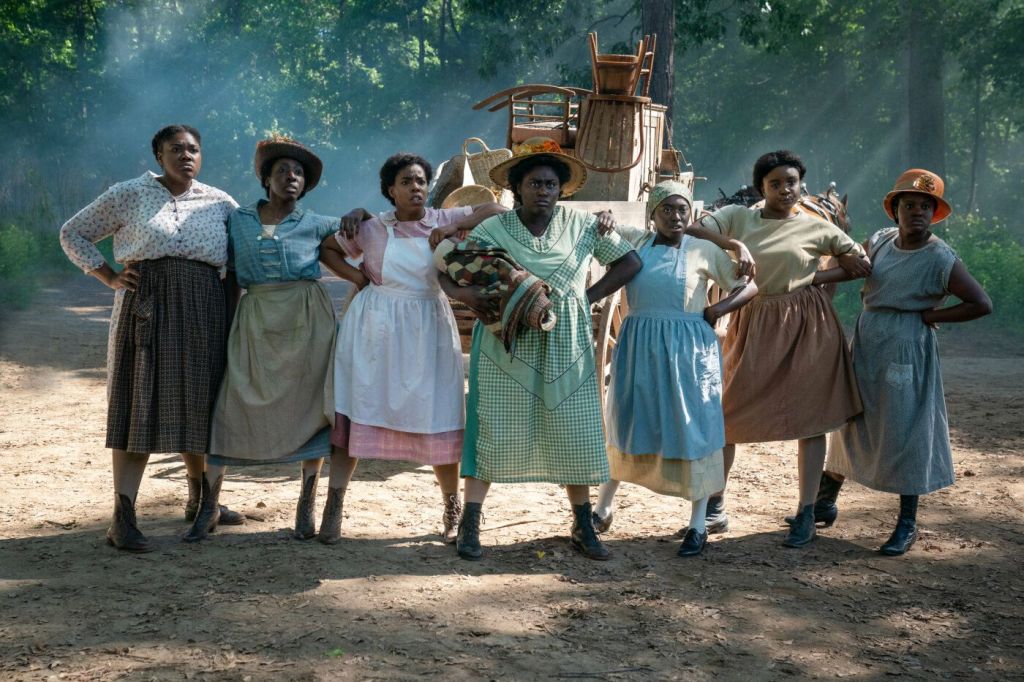
In all the Oscar hoohah last week surrounding the BARBIE snub (and I wasn’t happy about it either), a few other films received the cold shoulder from the Academy’s voters too. One of them was THE COLOR PURPLE, the musical adaptation of the stage play adaptation of Steven Spielberg’s 1985 movie adaptation of the Pulitzer Prize-winning book of the same name by Alice Walker. Though this new film, which is produced by Spielberg, Quincy Jones and Oprah Winfrey, has received much critical and audience praise, only Danielle Brooks (TV’s ORANGE IS THE NEW BLACK) received an Oscar nod for her performance as Sofia. The film’s star, AMERICAN IDOL winner Fantasia Barrino, who plays the oppressed Celie, was completely ignored.
If you’re not familiar with the story, THE COLOR PURPLE is set in rural Georgia and spans about 40 years, from 1909 to 1947, in the life of Celie Harris-Johnson, a woman who lives a life of poverty and abuse at the hands of the various men in her life. Throughout the years though, Celie maintains an indomitable spirit and the hope that one day she will be reunited with her two children, who were taken away from her at birth, and her younger sister Nettie.
It was bad enough that Spielberg took a wood plane to Walker’s original story, leaving only traces of the author’s evident misandry behind. In this version, the story is power sanded of all its warts and blemishes to the point where all the bad men in the story have their own come-to-Jesus moments. Hell no! If they’re going to be bad, keep them bad. Don’t make them into good people just so that the audience can smile when the final curtain falls or when the closing credits roll.
But that isn’t the most irksome part of this adaptation. The story is now structured as setup-song-setup-song-setup-song. I get that the source material is episodic in nature but what may work on stage doesn’t necessarily work on the screen. Rather than feeling immersed in the characters’ lives, I found myself apathetically waiting for the next song to come around. And as for those songs, most are completely forgettable. I was fully expecting Celie and the ladies to close out the show with a rousing rendition of Aretha Franklin’s “Sisters Are Doin’ It for Themselves” but, thankfully, that didn’t happen. Two of the show’s songs, however, are standouts. The first is Sofia’s “Hell No”, which she delivers with wonderful bravado. Right there, and this is early in the story, Brooks steals the film away from Barrino and even Barrino’s show stopper, “I’m Here”, can’t put the star back on equal footing with her co-star. That is why Brooks got the Oscar nomination and Barrino did not.
My biggest beef has nothing to do with the production though. It has to do with Walker herself. For someone who writes about repentance, Walker is surprisingly unrepentant when it comes to the positions she takes. She is an unabashed anti-Semitic conspiracy theorist and she has made no attempt to walk back any comments she has made on the subject. Perhaps Spielberg and Winfrey didn’t know about Walker’s neo-Nazi proclivity back in 1985 but they certainly knew about it in 2023. It’s very disappointing that they would choose to bury their heads in the sand over this when they are both loud voices against others who publicly espouse similar view to Walker.
So where does all this leave me on THE COLOR PURPLE? I just don’t get it. I don’t like the musical treatment. I don’t like that the original story, problematic as it is, was sanded down and reshaped into a feminist kumbaya. And I don’t like that Alice Walker continues to receive oxygen.
THE COLOR PURPLE is available now on multiple streaming platforms.
 Howard For Film
One thought on “Movie Review: The Color Purple (2023)”